What are the biggest benefits of minimalist living?
Minimalist living sounds very elegant, doesn’t it?
You imagine a Scandinavian apartment with white walls, one perfect chair, a single linen blanket, and a woman drinking herbal tea while looking peacefully out the window as if she has never once panic-bought throw pillows at HomeGoods.
Meanwhile, most of us are standing in the middle of our closets wondering why we own eight black shirts that are “completely different” and somehow still have nothing to wear.
Minimalism used to sound to me like deprivation. Like giving up things. Like living in an empty room with one spoon and a suspicious amount of inner peace.
But lately, I’ve started to understand it differently.
Minimalist living isn’t really about having less.
It’s about making room for more of what actually matters.
More peace.
More time.
More clarity.
More breathing space.
More mornings that don’t begin with digging through chaos while muttering, Where is my other shoe and why is my life like this?
More Sugimoto state of mind.
Quiet.
Intentional.
Stripped down.
Beautiful in its restraint.
Focused on what remains when the noise is removed.
And maybe, most importantly, it’s about learning the difference between what fills your home and what fills your soul.
Minimalism Gives You Peace of Mind
There is something deeply calming about space.
Not empty space in a sad, abandoned way. More like space that says, You can breathe here.
For a long time, I think I confused having things with being secure. If I had enough clothes, enough decorations, enough backups, enough just in case items, maybe life would feel more under control.
it did not.
It mostly gave me more things to clean, organize, move around, trip over, and feel guilty about not using.
Minimalism creates mental quiet. When your surroundings are less cluttered, your mind doesn’t have to process so much visual noise. You don’t walk into a room and immediately feel like 73 unfinished decisions are staring at you.
A clear space can become a clear invitation:
Sit down.
Drink your coffee.
Look out the window.
Pet the dog.
Exist without managing a museum of unnecessary objects.
that feels revolutionary.
Minimalism Saves Time…and Sanity
The more you own, the more you manage.
Every item becomes a tiny employee you didn’t hire but somehow have to supervise.
Clothes need washing.
Decor needs dusting.
Papers need sorting.
Drawers need reorganizing.
Random chargers need to be identified like suspects in a crime documentary.
Minimalism gives you time back because there is simply less to maintain.
Less searching.
Less cleaning.
Less decision fatigue.
Less I know I bought one of those, but where did I put it?
at a certain point, clutter becomes unpaid emotional labor.
You don’t just own the stuff. The stuff owns little pieces of your attention.
Minimalist living helps you reclaim those pieces.
Minimalism Makes You More Intentional
One of the biggest benefits of minimalist living is that it forces you to ask better questions.
Not –
Do I have room for this?
But-
Do I actually want this in my life?
That question changes everything.
Because sometimes we keep things not because we love them, but because they represent old versions of us.
The dress from a life we thought we’d have.
The dishes from a phase when we believed we’d become the kind of person who hosts elegant dinner parties instead of eating sushi in leggings.
The objects connected to guilt, obligation, fantasy, nostalgia, or the classic – But it was expensive.
Minimalism asks gently but firmly:
Does this still belong to who I am becoming?
That question has been powerful for me.
Especially in this season of life, where I’m rebuilding, healing, and learning what peace actually feels like. I’ve started to notice that I don’t want to drag every old thing into my new life.
Some things had their moment.
Some things served their purpose.
Some things were just taking up space where peace was trying to move in.
Minimalism Helps You Stop Performing
We live in a world that constantly tells us we need more.
More clothes.
More beauty products.
More gadgets.
More decorations.
More upgrades.
More proof that we are doing well.
Minimalism quietly rebels against that.
It says: maybe I don’t need to perform abundance. Maybe I can just live well.
That’s a big shift.
Because so much of what we buy is not really about need. It’s about identity. We buy the version of ourselves we hope to become.
The organized woman.
The elegant woman.
The healthy woman.
The artistic woman.
The woman who definitely uses matching storage containers and never has mystery leftovers in the fridge.
But minimalist living reminds us that we don’t become ourselves by purchasing props.
We become ourselves by paying attention.
By choosing what supports us.
By letting go of what distracts us.
By creating a life that feels honest from the inside, not impressive from the outside.
Minimalism Makes Beauty Stand Out
I love beauty.
I love black and white photography. I love clean lines. I love Scandinavian simplicity. I love contrast — something beautiful on the surface, but emotionally layered underneath.
Minimalism works the same way.
When there is less clutter, beauty has room to speak.
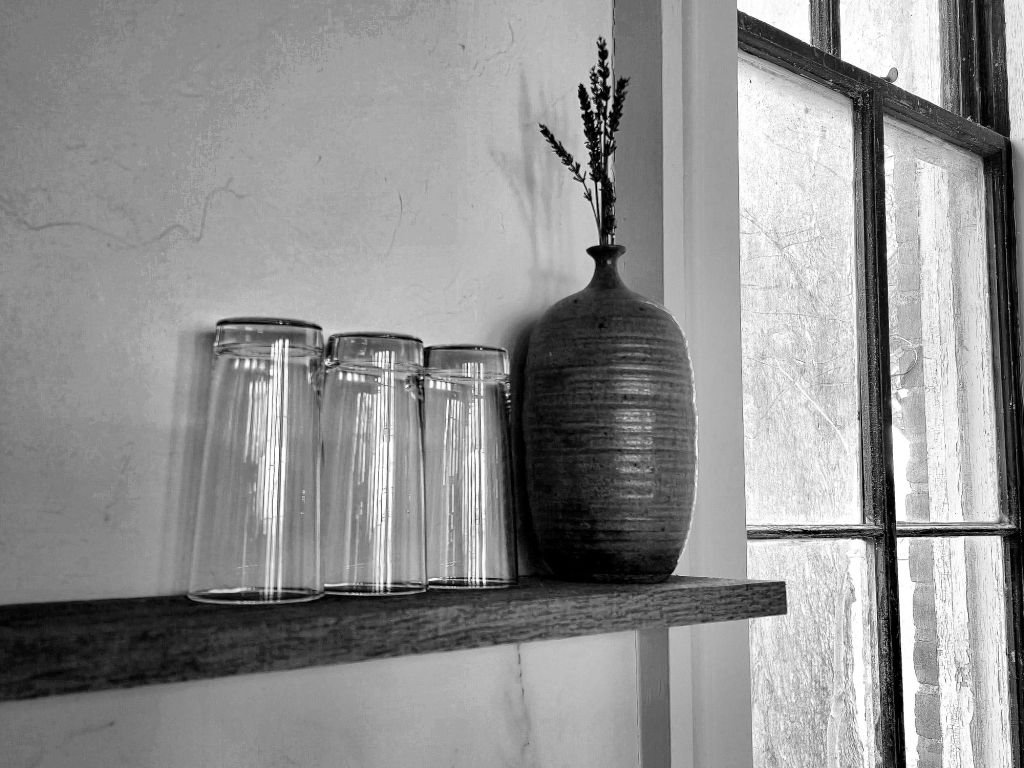
A single vase can become art.
A shadow on the wall becomes interesting.
A cup of coffee on a clean table feels almost cinematic.
A dog sleeping in a patch of sunlight becomes the entire point of the morning.
Minimalism doesn’t remove beauty.
It frames it.
It lets ordinary things become visible again.
And maybe that’s what I love most about it – minimalism teaches you to notice.
Minimalism Supports Sobriety and Healing
This one is personal.
In sobriety, I’ve been learning that peace is not boring. Peace is actually very luxurious.
There was a time when chaos felt normal to me. Emotional clutter, mental clutter, physical clutter — all of it blended together. Life felt loud. My mind felt loud. My habits were loud.
And when you’re used to chaos, calm can feel suspicious at first.
But healing has made me crave simplicity.
Not because I want an empty life, but because I want a truthful one.
I want mornings that don’t feel heavy.
I want a home that supports my nervous system instead of poking it with a stick.
I want routines that feel gentle.
I want space for walking, writing, swimming, coffee, gratitude, love, and breathing like a normal mammal.
Minimalism, for me, is becoming part of recovery.
It’s another way of saying:
I don’t want to numb.
I don’t want to hide.
I don’t want to keep collecting distractions.
I want to be present enough to enjoy what’s already here.
And what’s already here is actually a lot.
Minimalism Helps You Appreciate More
The thing about having less is that you often enjoy more.
When your closet isn’t stuffed, you actually wear what you love.
When your kitchen isn’t overflowing, cooking feels less like a hostage situation.
When your home isn’t packed with things, your favorite things become more meaningful.
Minimalism creates gratitude.
Not the forced kind where you write I am grateful for oxygen because you forgot to journal and need something quick.
Real gratitude.
The kind that notices:
This mug feels good in my hands.
This blanket is soft.
This room feels peaceful.
This dog is ridiculous and perfect.
This life, even imperfect, is mine.
And that is enough.
Minimalism Gives You Freedom
Stuff can become heavy.
Not just physically, although yes, especially when you’re moving boxes labeled miscellaneous and realizing miscellaneous is apparently your largest life category.
Stuff can be emotionally heavy too.
It ties us to old stories. Old expectations. Old identities. Old guilt.
Minimalism gives you permission to travel lighter.
To say:
I don’t need to keep everything.
I don’t need to prove anything.
I don’t need to own the whole world to feel safe in it.
There is freedom in knowing what matters.
There is freedom in closing a drawer and not fearing what lives inside.
There is freedom in walking into your home and feeling welcomed instead of attacked by laundry.
Small freedoms count.
Especially the laundry-related ones.
My Version of Minimalism
I don’t think I’ll ever be the kind of minimalist who owns exactly 33 items and folds socks with spiritual discipline.
I like black clothes too much.
I like books.
I like photography.
I like cozy things.
I like having options.
And I firmly believe a woman is allowed to own more than one candle if life has been difficult.
So my version of minimalism is not extreme.
It’s softer.
It’s not about stripping life down until it feels sterile.
It’s about editing life until it feels honest.
It’s about asking:
What do I use?
What do I love?
What brings peace?
What supports the woman I am becoming?
What is just clutter wearing sentimental perfume?
That last one is tricky.
Clutter is very manipulative. It knows how to say, But remember when…
Yes, I remember. And now you may go.
You’ll keep living in my memories and my photography if you deserve it…
The biggest benefit of minimalist living is not a cleaner house.
It’s a clearer life.
It’s waking up and feeling like your surroundings are not fighting you. It’s creating space for peace to enter without having to climb over old shoes, old stories, and three decorative baskets full of things you were definitely going to sort in 2019.
Minimalism is not about having nothing.
It’s about having enough.
Enough beauty.
Enough comfort.
Enough clarity.
Enough room to grow.
And maybe that’s the real dream:
Not a perfect white room with one designer chair.
But a life that feels lighter.
A life where your home, your mind, and your heart all have a little more space to breathe.
And if that space includes one very dramatic black outfit, a good cup of coffee, a sleeping dog, and absolutely no guilt over getting rid of the ugly mug from 2007?
That sounds like minimalism to me.

